
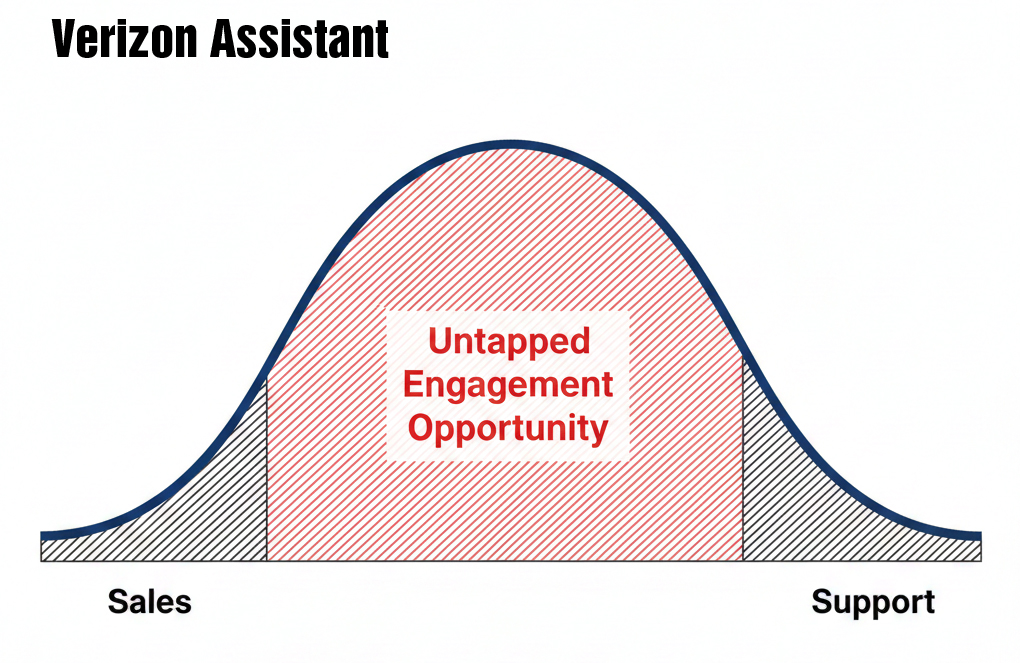
The Verizon Assistant (VZA) currently serves two primary use cases:
1. Sales
2. Support (technical or billing issues)
The Opportunity
Customers engage with Verizon daily—often extensively—yet they only interact with the VZA when they need to complete a specific task. Between sales and support lies a massive opportunity to position the VZA as a concierge partner that delivers genuinely useful, proactive experiences.
Deep customer loyalty emerges when customers feel the VZA has their back—not just solving problems, but preventing them and creating moments of thoughtfulness, surprise, or delight they might otherwise miss.
Examples
-
-
- Noticing increased data usage on a family member’s line and proactively offering a 60-day free trial upgrade
- Inviting an avid sports fan with the ESPN perk to an exclusive Verizon watch party
-
Strategic Repositioning
The goal is to transform the VZA from a transactional tool into a “trusted confidant” that prioritizes customer interests—not a corporate barrier between customers and human agents.
AI-Powered Personalization
Machine learning enables truly individualized plans based on complex usage pattern analysis. The VZA could dynamically adjust services and costs to match actual usage—for example, automatically switching between unlimited and throttled data based on weekly patterns, crediting customers who are overpaying, and notifying them of the savings.
The Vision
Verizon customers are customers 365 days a year, not just when problems arise. Aligning with Verizon’s customer-first mandate, the VZA can become integral to the mobile experience—making engagement delightful rather than merely functional.
The strategic target: transform satisfied VZA users into evangelists that competitor customers envy.
Strategic Analysis: Competing Agentic AI Strategies in the U.S. Telecommunications Market
1. Introduction: The Agentic AI Paradigm Shift
The U.S. telecommunications market is undergoing a significant strategic transformation, driven by a move beyond simple, rule-based chatbots toward the deployment of advanced, agentic AI systems. These sophisticated agents are designed to operate independently—to interpret information, make decisions, and take meaningful, autonomous actions without requiring direct human intervention. This evolution is fundamentally redefining the benchmarks for customer experience, operational efficiency, and competitive positioning across the industry.
This analysis will examine and compare the divergent agentic AI strategies of major mobile network operators (MNOs) against those of secondary competitors, including Cable Operators and Mobile Virtual Network Operators (MVNOs). It will place a specific focus on non-transactional use cases—those designed to provide proactive value and convenience—and their profound implications for achieving market leadership in the new AI-driven era. We begin with an analysis of the major competitors who are leading this technological shift, using proprietary AI platforms to build deep, defensible moats.
2. Major Competitors: The Race for Agentic Dominance
The nation’s largest mobile network operators, particularly T-Mobile and AT&T, are making significant, multi-year investments in proprietary agentic AI platforms. Their strategies signal a critical shift in the competitive landscape, where market differentiation is increasingly being built on superior, AI-driven customer experiences rather than on price alone. By developing deeply integrated, autonomous agents, these carriers aim to create powerful competitive moats that are difficult for smaller rivals to replicate.
2.1. T-Mobile: The Autonomous Customer Experience Engine (IntentCX)
Through a strategic partnership with OpenAI, T-Mobile is developing IntentCX, a custom, intent-driven AI decisioning platform. This system represents a major architectural leap beyond traditional “Next Best Action” systems, which operate from a fixed library of options. IntentCX is engineered to comprehend complex, multi-threaded conversations, maintain context across interactions, and operate in multiple languages, mirroring the capabilities of advanced AI models.
The core competitive advantage of IntentCX is its deep integration into T-Mobile’s core operational and transaction systems, allowing the agent to deliver actual solutions. By autonomously executing tasks with customer permission, it fundamentally reduces customer effort and cognitive load, breaking the industry’s reliance on reactive, high-friction support models. This ability to proactively preserve revenue and customer lifetime value—evidenced by a reported 20% reduction in churn and a 30% increase in renewals—is the key to creating a durable, experience-based competitive moat. The platform is being trained on billions of data points from customer interactions and real-time network experience data, enabling it to resolve issues with a high degree of precision.
- Strategic Impact on Customer Journeys
- Seamless Onboarding: The use of seamless, autonomous workflows has driven significant digital adoption. For instance, these automated processes handled 75% of iPhone preorders digitally, a testament to their ability to eliminate friction in complex sign-up journeys.
- Human-AI Collaboration: The “Team of Experts” model augments human agents with AI-driven insights, achieving 40% higher retention rates compared to purely automated or purely human-operated systems.
T-Mobile’s aggressive AI acquisition strategy was highlighted by its “Easy Switch” tool. This feature used AI bots to scrape customer data from competitors’ secure websites to generate optimized switching offers. This tactic ultimately led to a lawsuit from AT&T, which alleged the data scraping was unlawful, demonstrating the intense competitive pressures fueling these AI initiatives.
2.2. AT&T: The Trust-First Personal Agent
AT&T is pursuing a deliberate, phased agentic AI strategy focused on building customer trust through high-value security and utility functions before expanding into broader lifestyle services. This approach aims to establish the carrier-provided AI as a trusted guardian of the customer’s digital life, paving the way for deeper integration and loyalty.
The “Digital Receptionist”
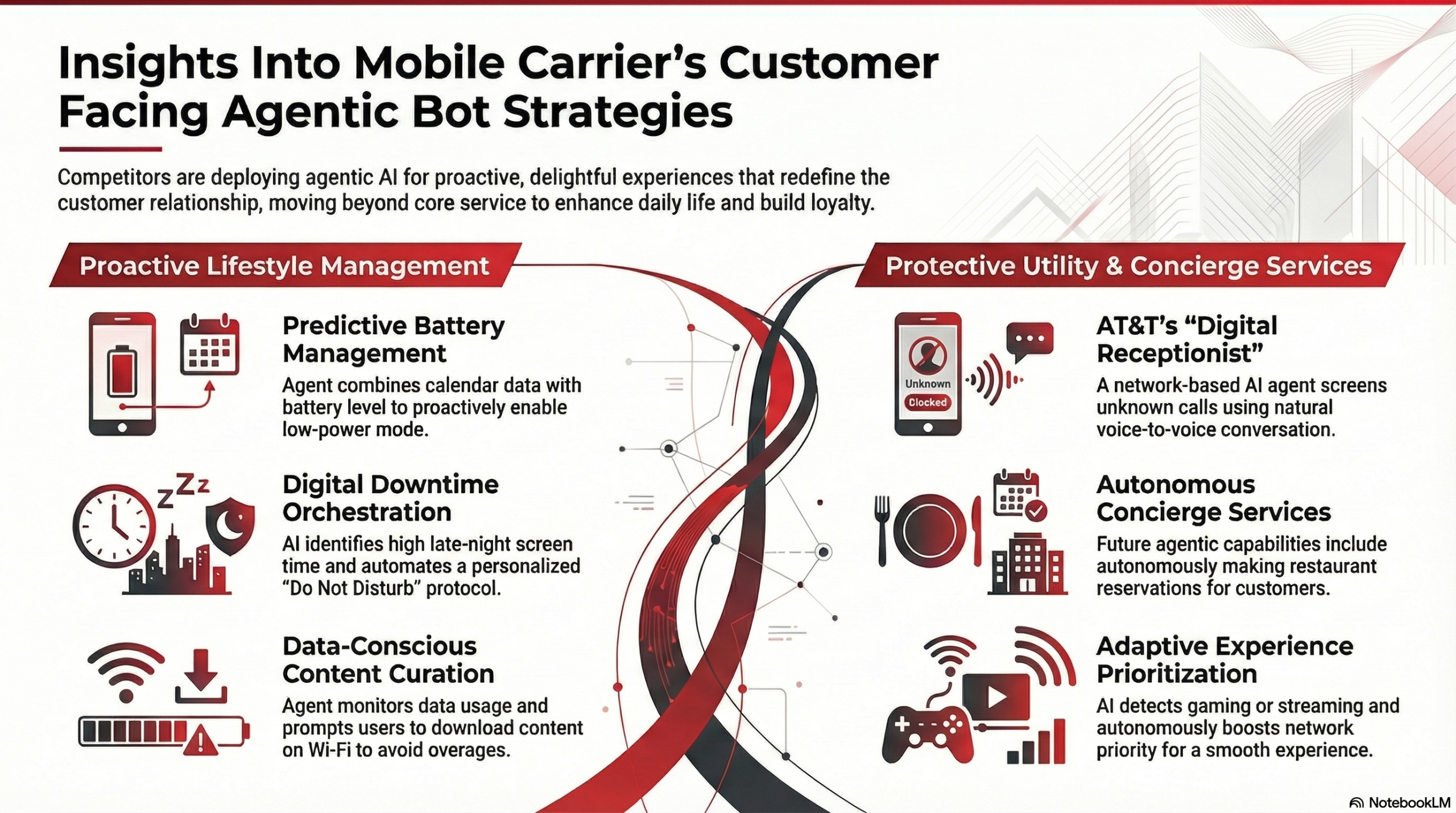
A key non-transactional use case is the Digital Receptionist, a network-based agent designed to combat the pervasive issue of spam and fraud calls. This system uses advanced voice-to-voice AI to answer and screen unknown callers on the customer’s behalf, engaging them in a natural conversation.
Leveraging decades of fraud and spam data, the agent can automatically block suspicious calls. While the screening occurs, the customer can view a live transcript on their device and choose to intercept the call at any time. By providing this premium filtering service, AT&T delivers a “delightful” utility focused on digital peace of mind, establishing the foundational trust necessary for future agentic services.
Vision for an Autonomous Lifestyle Concierge
The Digital Receptionist serves as a strategic entry point for AT&T’s broader vision of an AI agent that functions as a personal lifestyle assistant. This forward-looking strategy aims to make the carrier’s service “stickier” by embedding it into the customer’s daily activities.
Projected agentic capabilities include:
- Autonomously connecting the customer to make reservations at highly sought-after restaurants.
- Obtaining critical information from callers based on real-time text prompts provided by the user during an active call.
AT&T’s approach, like T-Mobile’s, illustrates how major operators are using high-investment, experience-led AI strategies to create indispensable services. This stands in stark contrast to the efficiency-driven approach of secondary competitors.
3. The “Delightful” Agent: Non-Transactional Value Creation
The most advanced agentic AI strategies deliberately transcend traditional sales or support functions. Instead, they focus on providing proactive value, convenience, and well-being enhancements that operate autonomously in the background of a customer’s life. The following examples represent the art of the possible, illustrating the strategic direction of non-transactional value creation in the industry. By anticipating needs and solving minor frustrations before they arise, these “delightful” agents forge a deeper and more resilient form of brand loyalty.
3.1. Proactive Well-Being and Device Management
Agentic AI systems can improve a customer’s quality of life by managing their digital environment for them. This is achieved by combining device, calendar, and location data to act as a helpful, invisible partner.
- Predictive Battery Management: The agent analyzes the phone’s battery level in conjunction with the user’s predicted departure time, which is inferred from calendar and location history. If it determines the battery will not last, the agent proactively enables low-power mode early and sends a gentle reminder, ensuring the device remains available when needed most.
- Digital Downtime Orchestration: By identifying patterns of high screen time late at night, the AI agent can suggest and automate a personalized “Digital Sunset” mode. Without user input, it can silence non-essential notifications and adjust the screen to a blue-light-filtered mode, helping the user wind down.
3.2. Hyper-Personalized Content Curation
Data-Conscious Curation is an agentic function designed to help customers avoid the pain point of data overage fees. The AI agent monitors a user’s data plan in real-time. As the data cap approaches, it proactively recommends downloading content while the user is on their home network or suggests content that is available at nearby free Wi-Fi spots. This preemptive action transforms the carrier from a source of potential billing anxiety into a helpful partner in managing digital consumption.
These non-transactional applications showcase a strategic shift toward using AI to build relationships based on proactive care and convenience, a stark contrast to the efficiency-focused strategies of secondary competitors.
4. Secondary Competitors: The Efficiency Imperative
Unlike the major MNOs investing in high-autonomy agents for customer experience differentiation, secondary competitors such as Cable Operators and MVNOs deploy AI with a primary focus on operational efficiency. For these companies, AI is a tool for cost reduction and high-volume inquiry deflection, which is essential to protecting their price-sensitive business models.
4.1. Cable Operators (Comcast/Xfinity, Spectrum): High-Volume Deflection
Cable operators utilize conversational AI platforms to filter and autonomously handle a large percentage of routine customer inquiries. For example, Comcast uses platforms like Replicant to resolve up to 80% of Tier 1 and Tier 2 tasks without human intervention. These automated tasks include answering billing questions, resetting modems, and rescheduling technician appointments.
The strategic driver for this approach is not just cost savings but also a deliberate effort to improve customer satisfaction. Cable operators are strategically weaponizing automation to fix a historically broken and often outsourced human support model. By replacing frustrating, low-quality human interactions with fast, consistent, and reliable AI-powered resolutions, they are counterintuitively improving CSAT.
4.2. Mobile Virtual Network Operators (MVNOs): Automation for Cost Control
The thin profit margins of MVNOs, such as TracFone (operator of Total Wireless), dictate an AI strategy centered almost exclusively on maximizing self-service and reducing the cost-to-serve. Their AI adoption is focused on automating simple tasks like data entry, balance checks, and plan refills through tools like automated text services (e.g., “611611”) and basic chatbots.
However, this intense focus on cost reduction has led to documented customer service failures. According to consumer forums, the inability to reach a human representative by phone has become so common it is “practically synonymous with the brand itself,” leaving customers trapped in automated loops when they encounter issues that require human intervention. This creates a significant service gap, positioning MVNOs to compete solely on price rather than on an innovative or “delightful” customer experience.
The starkly different approaches to AI implementation have a direct and profound impact on the end-user experience.
5. User Experience Analysis: The Duality of Agentic AI
The quality of implementation is the single most critical factor determining the success of an agentic AI strategy. Customer feedback reveals a sharp duality: a well-designed agentic system can provide a superior alternative to human interaction, while a poorly executed one becomes a significant source of frustration and brand damage.
5.1. When Bots Surpass Human Agents
From the customer’s perspective, the best agentic AI systems provide clear advantages over traditional support channels.
- “You Already Know My Situation” Customers highly value an AI agent that retains the full context of their history, including past interactions, device information, and account status. This eliminates the need to repeat information, reducing the emotional and effort burden of contacting support.
- “Fix It Without a Fight” A major point of delight is an AI that can autonomously inspect a bill, detect an error, and immediately propose and execute a credit. This removes the need for customers to argue their case or escalate the issue, creating a frictionless resolution experience.
- “Faster and More Controllable” For simple, task-oriented jobs like activating a service or checking a balance, customers prefer agentic flows. They are significantly faster than waiting on hold for a human agent and can be completed at the user’s own pace.
5.2. Common Failures of Agentic Implementation
When AI is poorly implemented, it can create an experience that feels far worse than traditional human support.
- “Trapped in Automated Loops” Customer frustration peaks when automation acts as a gatekeeper rather than a problem-solver. Being forced through scripted steps that fail to address the issue or escalate properly to a competent human leaves customers feeling stonewalled and powerless.
- “Pushy Sales During a Support Journey” A common pitfall is over-optimizing the AI for sales. When an agent pushes irrelevant upgrades or cross-sells during a technical support interaction, customers feel exploited and react negatively. This erodes trust and damages the perception of the AI as a helpful assistant.
These user experiences directly inform the strategic positioning and competitive potential of different AI approaches in the market.
6. Strategic Implications and Market Positioning
The analysis reveals that agentic AI is not merely an incremental technological upgrade; it is fundamentally reshaping the competitive dynamics of the U.S. telecommunications industry. The strategic choices made by operators today—whether to prioritize experience-led innovation or efficiency-driven cost control—will determine their market position for years to come.
6.1. A Widening Competitive Divide
AI adoption is creating a clear stratification in the market. On one side, major operators like T-Mobile and AT&T are deploying high-autonomy agents to compete on differentiated, high-value customer experiences. Their goal is to build deep brand loyalty by transforming the carrier-customer relationship into one of proactive, personalized assistance. On the other side, secondary competitors, including Cable MVNOs and traditional MVNOs, are using AI primarily for operational efficiency and cost control. This approach allows them to defend their price-sensitive market positions but limits their ability to compete on service innovation or customer delight.
6.2. The High-Trust Personal Agent as the Next Frontier
The future competitive battlefield will not just be about providing connectivity but about becoming the default “lifestyle operating system” for the customer. Market leadership will increasingly belong to the provider that can successfully evolve from a simple utility into a seamless, high-trust digital assistant integrated into the customer’s daily life. This reframes the competition as not just between carriers, but as a battle against OS providers like Apple and Google for control over the customer’s daily digital interactions. The success of initial trust-building features, such as AT&T’s Digital Receptionist, is a critical prerequisite. Only by first proving themselves as trusted guardians can carriers earn the right for their agents to be delegated higher-autonomy lifestyle tasks.